Master Thesis about Real-time Liquid Simulation with Unity DOTS
University
IT University of Copenhagen
Game
Liquid Simulation in DOTS
Date
2026
Duration
3 Months
Team Size
Solo
This master thesis project investigates whether Position-Based Material Point Method can be implemented as a practical real-time liquid solver in Unity DOTS. The other part of this research is to determine the feasability in modern games to use a solution like this for liquid simulations during run time.
The work follows Lewin's PB-MPM formulation and his WebGPU prototype closely at the algorithmic level, but the Unity version changes two important constraints: it runs on the CPU rather than the GPU, and it extends the method from 2D to 3D. The thesis implementation is intentionally scoped to the liquid branch of PB-MPM so the evaluation can focus on solver architecture, particle-grid transfers, collision handling, and measured runtime behavior.
Important Links
Software Architecture
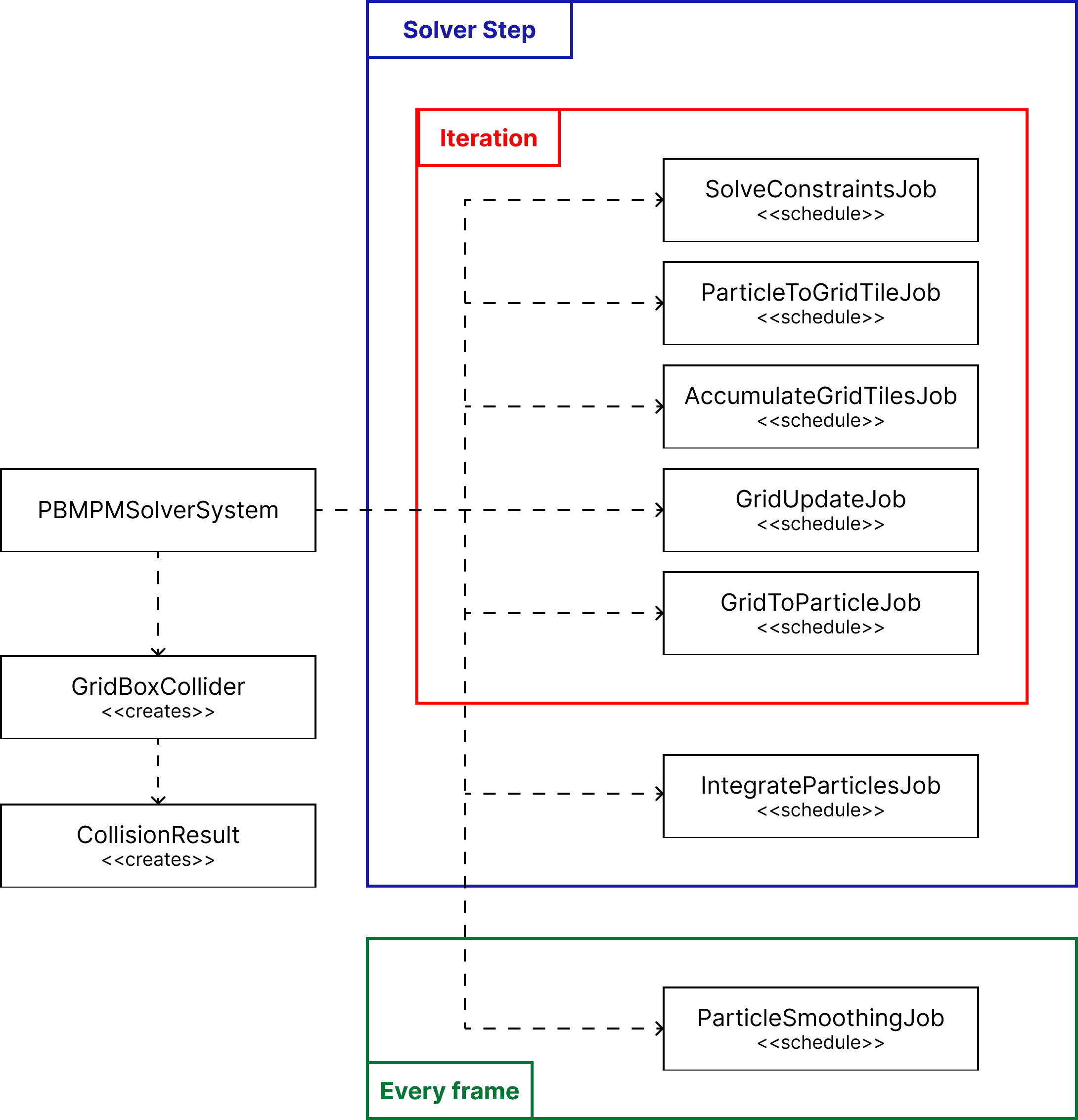
The central runtime system isPBMPMSolverSystem. It owns the fixed-size solver step scheduling, runs the PB-MPM stages as separate jobs, rebuilds the collider cache used inside those jobs, and applies a final smoothing pass for presentation. Rather than attaching the simulation to Unity's default fixed physics loop, the system accumulates frame time manually and executes the required number of solver substeps at the configured solver frequency.
A solver step advances the simulation by a fixedDeltaTime. Inside one solver step, the PB-MPM loop can be executed multiple times before the particles are finally integrated. That separation between solver frequency and iteration count is important in practice, because it makes the runtime cost of stability tuning visible and measurable instead of hiding it inside one monolithic update.
private void ScheduleParticleJobs(
    ref SystemState state,
    int iterationCount,
    GridInterpolationMode interpolationMode,
    bool useGridVolumePreservation)
{
    var gridEntities = _gridQuery.ToEntityArray(Allocator.TempJob);

    for (int substepIndex = 0; substepIndex < _solverSubsteps; substepIndex++)
    {
        for (int iterationIndex = 0; iterationIndex < iterationCount; iterationIndex++)
        {
            _gridIterationId++;
            RunSolverIteration(
                ref state,
                gridEntities,
                interpolationMode,
                useGridVolumePreservation,
                applyParticleGravity: iterationIndex == iterationCount - 1);
        }

        ScheduleIntegrateParticles(ref state);
    }

    ScheduleSmoothing(ref state);
    state.Dependency = gridEntities.Dispose(state.Dependency);
}

private void RunSolverIteration(
    ref SystemState state,
    NativeArray<Entity> gridEntities,
    GridInterpolationMode interpolationMode,
    bool useGridVolumePreservation,
    bool applyParticleGravity)
{
    ScheduleSolveConstraints(ref state, useGridVolumePreservation);
    ScheduleParticleToGrid(ref state, gridEntities, interpolationMode);
    ScheduleUpdateGrid(ref state, gridEntities, interpolationMode);
    ScheduleGridToParticle(
        ref state,
        gridEntities,
        interpolationMode,
        useGridVolumePreservation,
        applyParticleGravity);
}
Core runtime data
The architecture stays close to the PB-MPM paper, but the data layout is adapted to Unity's ECS model. Instead of storing the whole simulation in one object graph, the runtime is organized around a small set of explicit data containers:
- Particles are ECS entities with a ParticleComponent storing physical state such as position, displacement, deformation gradient, deformation displacement, liquid density, and velocity.
- The background grid is a separate ECS entity with a GridComponent and a DynamicBuffer for GridCells containing the per-node mass, volume, displacement, and last-touched iteration.
- Collision data is copied from Unity Physics box colliders into a compact native collider cache before the solver jobs run, so the jobs do not need to query scene objects directly.
- Particle initialization is handled by a dedicated spawn pipeline that turns authored spawn volumes into runtime ECS particle entities once at startup.
One detail that mattered a lot here is that the grid topology is baked once and then reused. The grid entity stores its global dimensions in GridComponent, while the dynamic buffer holds one GridCell entry per grid node. That keeps the memory layout dense and makes it straightforward for jobs to iterate over the grid without constantly rebuilding topology information.
public override void Bake(GridAuthoring authoring)
{
    var entity = GetEntity(authoring, TransformUsageFlags.Dynamic);
    AddComponent(entity, authoring.CreateGridComponent());
    AddComponent(entity, new GridAuthoringReference
    {
        AuthoringInstanceId = authoring.GetInstanceID()
    });

    var gridCells = AddBuffer<GridCell>(entity);
    authoring.RebuildGridCells(gridCells);
}

public void RebuildGridCells(DynamicBuffer<GridCell> gridCells)
{
    GridComponent grid = CreateGridComponent();
    int3 cellCounts = GridUtilities.GetCellCounts(grid);
    int3 nodeCounts = cellCounts + 1;

    gridCells.Clear();
    gridCells.EnsureCapacity(nodeCounts.x * nodeCounts.y * nodeCounts.z);

    for (int x = 0; x < nodeCounts.x; x++)
    {
        for (int y = 0; y < nodeCounts.y; y++)
        {
            for (int z = 0; z < nodeCounts.z; z++)
            {
                gridCells.Add(new GridCell
                {
                    Coordinates = new int3(x, y, z),
                    WeightedDisplacement = float3.zero,
                    Displacement = float3.zero,
                    Mass = 0f,
                    Volume = 0f,
                    LastTouchedIteration = 0
                });
            }
        }
    }

    gridCells.TrimExcess();
}
Authoring And Data Preparation
The simulation can still be authored from regular Unity scene objects. Bakers convert those authoring objects into compact ECS data before runtime. For the grid, that means turning a configured simulation volume into one grid entity plus its node buffer. For particle sources, the baker stores a compact spawn description rather than every particle position explicitly.
The spawn pipeline only supports a box volume in the current version, but the data representation is already set up in a way that scales cleanly: a spawn component stores counts per axis, a local start position, and a local step size. TheParticleSpawnSystem reconstructs the actual particle positions from that compact description, writes the initial transform and ParticleComponent values, computes the particle volume from the local step size, and then disables itself after the one-time initialization pass.
Solver Stages
Each solver iteration follows the same stage order as the PB-MPM paper: solve constraints, transfer particle state to the grid, update grid nodes, transfer the corrected state back to the particles, and finally integrate particle state after all iterations of the current solver step are complete. Splitting the pipeline into separate jobs made it possible to profile each stage in isolation and adjust the data flow where Unity's threading model demanded it.
Liquid constraint projection
The constraint stage implements the liquid branch of PB-MPM. For every particle, the solver reads the current deformation displacement tensor, splits it into volumetric and shear parts, and applies hydrostatic and viscous corrections directly to that tensor. The implementation can optionally use a grid-measured density value instead of relying only on the particle's local deformation history, which improves volume preservation when the iterative solve has not fully converged.
private void Execute(ref ParticleComponent particle)
{
    float3x3 D = particle.DeformationDisplacement;
    float c = D.c0.x + D.c1.y + D.c2.z;
    float deformationVolume =
        math.max(math.determinant(particle.DeformationGradient), 1e-4f);
    float particleLocalLiquidDensity = 1f / deformationVolume;
    float liquidDensity = UseGridVolumePreservation
        ? math.max(particle.GridMeasuredLiquidDensity, 1e-4f)
        : math.max(particleLocalLiquidDensity, 1e-4f);

    float3x3 dHydro = float3x3.identity * (liquidDensity - 1f - c);
    float3x3 dVisc = -(D - c * float3x3.identity);

    D += particle.LiquidHydroFactor * dHydro;
    D += particle.LiquidViscosityFactor * dVisc;

    particle.DeformationDisplacement = D;
    particle.LiquidDensity = liquidDensity;
}
This is the point where the project differs most clearly from a force-accumulation solver. Material behavior is expressed through local constraint corrections, while the particle-grid transfers are responsible for propagating those corrections across the simulation domain.
Two-stage particle-to-grid transfer
The particle-to-grid transfer is the most important concurrency problem in the whole solver. Every particle influences a quadratic B-spline support of 3 x 3 x 3 grid nodes, so naive parallel writes would immediately collide. The solution used in the thesis is a tiled two-stage transfer.
The first job does not write to the grid at all. It determines which grid tiles a particle touches and stores a compact particle record for each of those tiles. A second job then processes the active tiles independently, clears the cells inside the current tile, and accumulates only the particle records assigned to that tile. This is where mass, volume, and the affine displacement-related term are written into the grid.
public void Execute(int index)
{
    int tileIndex = ActiveTiles[index];
    int3 nodeCounts = GridUtilities.GetNodeCounts(Grid);
    int3 tileCounts = GridUtilities.GetTileCounts(nodeCounts, TileSize);
    int3 tileCoordinates = GridUtilities.GetTileCoordinates(tileCounts, tileIndex);
    int3 tileMin = tileCoordinates * TileSize;
    int3 tileMax = math.min(tileMin + TileSize, nodeCounts);

    ClearTile(tileMin, tileMax, nodeCounts);

    NativeParallelMultiHashMapIterator<int> iterator;
    GridTileParticleRecord particleRecord;
    if (!TileParticles.TryGetFirstValue(tileIndex, out particleRecord, out iterator))
    {
        return;
    }

    do
    {
        AccumulateParticle(ref particleRecord, tileMin, tileMax, nodeCounts);
    } while (TileParticles.TryGetNextValue(out particleRecord, ref iterator));
}

private void AccumulateParticle(
    ref GridTileParticleRecord particle,
    int3 tileMin,
    int3 tileMax,
    int3 nodeCounts)
{
    if (!GridUtilities.TryGetQuadraticWeights(
            Grid,
            particle.Position,
            out QuadraticWeights3D weights))
    {
        return;
    }

    for (int xOffset = 0; xOffset < 3; xOffset++)
    {
        for (int yOffset = 0; yOffset < 3; yOffset++)
        {
            for (int zOffset = 0; zOffset < 3; zOffset++)
            {
                int3 offset = new int3(xOffset, yOffset, zOffset);
                int3 supportCoordinates = weights.BaseCoordinate + offset;
                if (!GridUtilities.IsInsideNodeCounts(nodeCounts, supportCoordinates) ||
                    !GridUtilities.IsInsideTile(tileMin, tileMax, supportCoordinates))
                {
                    continue;
                }

                float weight = weights.GetWeight(offset);
                if (weight <= 0f)
                {
                    continue;
                }

                int gridIndex = GridUtilities.GetGridIndex(
                    nodeCounts,
                    supportCoordinates.x,
                    supportCoordinates.y,
                    supportCoordinates.z);
                float3 supportPosition = GridUtilities.GetGridPosition(
                    Grid,
                    supportCoordinates,
                    InterpolationMode);
                float3 relativePosition = supportPosition - particle.Position;

                GridCell cell = GridCells[gridIndex];
                cell.Mass += weight * particle.Mass;
                cell.WeightedDisplacement +=
                    weight *
                    particle.Mass *
                    (particle.Displacement +
                     math.mul(particle.DeformationDisplacement, relativePosition));
                cell.Volume += weight * particle.Volume;
                GridCells[gridIndex] = cell;
            }
        }
    }
}
That design keeps the implementation close to the PB-MPM data flow while fitting Unity's multithreaded execution model. Importantly, it also means inactive tiles and untouched cells can be skipped later in the pipeline instead of paying a full-grid cost on every iteration.
Grid update and collisions
After accumulation, each active grid node holds mass, volume, and mass-weighted displacement rather than a final nodal state.GridUpdateJob normalizes the accumulated displacement by nodal mass, reconstructs the node's world-space support position, and resolves collisions directly on the grid.
Collision handling is implemented against a cached set of box colliders built from Unity Physics data before the jobs start. For each collider, the displaced support position is tested and the penetrating normal component is projected away. TheLastTouchedIteration marker is used here to skip stale cells, which keeps the update tied to the actually active parts of the grid.
public void Execute(int index)
{
    GridCell cell = GridCells[index];

    if (cell.LastTouchedIteration != CurrentGridIteration || cell.Mass <= 0f)
    {
        return;
    }

    float3 supportPosition = GridUtilities.GetGridPosition(
        Grid,
        cell.Coordinates,
        InterpolationMode);

    cell.Displacement = cell.WeightedDisplacement / cell.Mass;

    foreach (var collider in Colliders)
    {
        float3 displacedSupportPosition = supportPosition + cell.Displacement;
        GridBoxCollider.CollisionResult collision =
            collider.Collide(displacedSupportPosition);
        if (collision.Collides)
        {
            float gap = math.min(
                0f,
                math.dot(collision.Normal,
                         collision.PointOnCollider - supportPosition));
            float penetration =
                math.dot(collision.Normal, cell.Displacement) - gap;
            float radialImpulse = math.max(penetration, 0f);
            cell.Displacement -= radialImpulse * collision.Normal;
        }
    }

    GridCells[index] = cell;
}
Grid-to-particle reconstruction
Once the grid contains corrected nodal displacements, the solver transfers that state back to the particles. The same quadratic B-spline neighborhood is sampled again, but now it is used to reconstruct three different quantities: the particle displacement, an affine local deformation term, and a grid-measured liquid density value.
The affine term is written back in displacement form asDeformationDisplacement, so the later integration step can update the deformation gradient. Gravity is added only on the final iteration of the current solver step. Applying it during every iteration would effectively multiply gravity by the iteration count.
for (int xOffset = 0; xOffset < 3; xOffset++)
{
    for (int yOffset = 0; yOffset < 3; yOffset++)
    {
        for (int zOffset = 0; zOffset < 3; zOffset++)
        {
            int3 offset = new int3(xOffset, yOffset, zOffset);
            int3 supportCoordinates = weights.BaseCoordinate + offset;
            if (!GridUtilities.IsInsideNodeCounts(nodeCounts, supportCoordinates))
            {
                continue;
            }

            float weight = weights.GetWeight(offset);
            if (weight <= 0f)
            {
                continue;
            }

            int cellIndex = GridUtilities.GetGridIndex(
                nodeCounts,
                supportCoordinates.x,
                supportCoordinates.y,
                supportCoordinates.z);
            GridCell cell = gridCells[cellIndex];
            if (cell.LastTouchedIteration != CurrentGridIteration)
            {
                continue;
            }

            float3 supportPosition = GridUtilities.GetGridPosition(
                grid,
                supportCoordinates,
                InterpolationMode);
            float3 relativePosition = supportPosition - particle.Position;

            displacement += weight * cell.Displacement;
            c += 4f * GridUtilities.OuterProduct(cell.Displacement, relativePosition) *
                (weight * inverseCellSizeSquared);
            gridMeasuredLiquidDensity +=
                weight * cell.Volume * inverseCellVolume;
        }
    }
}

particle.Displacement = displacement;
if (ApplyParticleGravity)
{
    particle.Displacement += GravityDisplacement;
}

particle.DeformationDisplacement = c * DeltaTime;
particle.GridMeasuredLiquidDensity = math.max(gridMeasuredLiquidDensity, 1e-4f);
if (UseGridVolumePreservation)
{
    particle.LiquidDensity = particle.GridMeasuredLiquidDensity;
}
Particle integration and visual smoothing
After the iteration loop finishes for the current solver step, particle state is integrated. The implementation advances particle position by the reconstructed displacement, updates the deformation gradient with I + D, performs a final particle-level collision correction, reconstructs velocity from displacement and time step, and writes the result back toLocalTransform.
private void Execute(
    ref ParticleComponent particle,
    ref LocalTransform transform)
{
    particle.Position += particle.Displacement;

    particle.DeformationGradient = math.mul(
        float3x3.identity + particle.DeformationDisplacement,
        particle.DeformationGradient);

    foreach (var collider in Colliders)
    {
        GridBoxCollider.CollisionResult collision =
            collider.Collide(particle.Position);
        if (collision.Collides)
        {
            particle.Displacement -= collision.Penetration * collision.Normal;
            particle.Position -= collision.Penetration * collision.Normal;
        }
    }

    particle.Velocity = particle.Displacement / DeltaTime;
    transform.Position = particle.Position;
}
The final smoothing pass is intentionally separated from the physical solve. When the solver frequency is low, for example 15 Hz, the physical state advances in visible steps. The smoothing system updates only the rendered transform every frame using the current particle velocity so the simulation remains visually smoother without altering the actual solver state.
Validation And Visual Behavior
Before measuring runtime or memory, I first checked whether the solver behaves in a visually plausible way. Two validation scenes were used for this: one showing the liquid flowing through and around static colliders, and one testing interaction with a moving collider. The main requirement was stability, and the solver stayed stable across the tested particle counts without exploding or producing uncontrolled particle displacements.
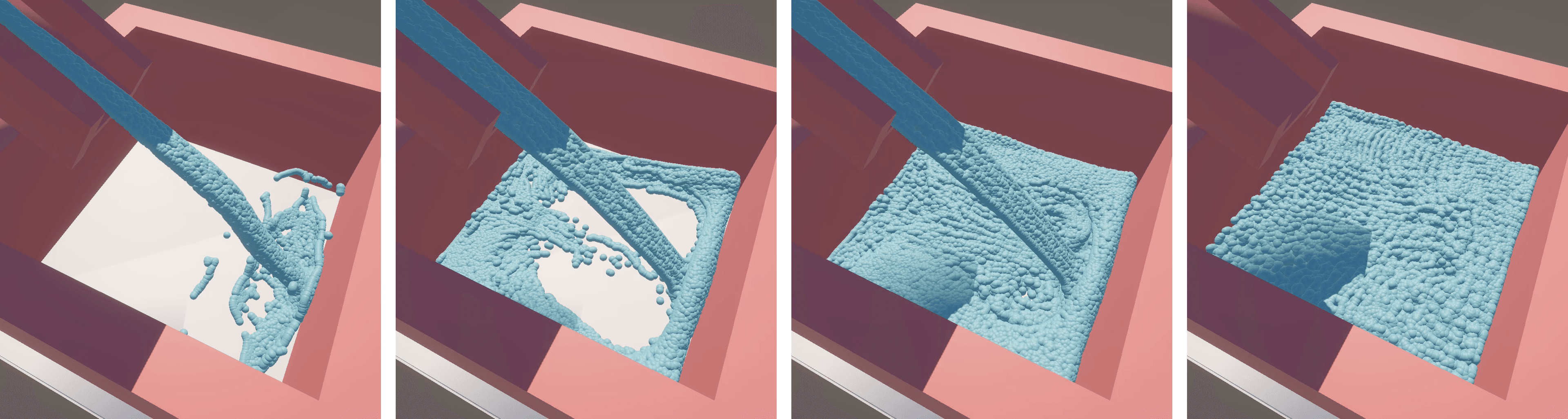
Each of the four tunable parameters also has a clear visual signature, independent of its cost. Higher particle counts produce a more convincing, coherent liquid, though at very high counts the resulting low frame rate starts to reveal limitations when interacting with fast-moving geometry. A low solver frequency, such as 10 Hz, causes visible stuttering that the smoothing pass can soften but not fully hide, while higher frequencies make the material read as visually stiffer. More solver iterations push the material toward the same stiffer look, since the constraints are resolved more fully before the particles are integrated. Grid resolution behaves similarly: a fine grid, such as a cell size of 0.3, makes the liquid look more bouncy and fluid, while very coarse grids introduce visible pulsating artifacts.
Performance Analysis
A large part of the thesis work was building the prototype in a way that supports profiling rather than only demonstration. The Unity debug overlay exposes solver frequency, iteration count, interpolation mode, grid volume preservation, and several scene parameters at runtime. Execution time was measured with C#'sStopwatch class around PBMPMSolverUpdate(), the method that rebuilds the collider cache and schedules the PB-MPM jobs. All tests ran in Unity 6000.3.11f1 on an AMD Ryzen 7 7840HS, an NVIDIA GeForce RTX 4070 Laptop GPU, and 32 GB of DDR5 RAM, with particle count, solver frequency, solver iteration count, and grid cell count varied one at a time against a shared baseline of 31,250 particles, 1 solver iteration, 137,700 grid cells, and a 30 Hz solver frequency. That baseline produced a mean PBMPMSolverUpdate() time of 3.428 ms.
Key runtime measurements from the thesis:
- Particle count: tested from 2,000 to 250,000 particles across 41 configurations. Runtime increases in a clear linear pattern, roughly O(P), with the baseline of 31,250 particles at 3.428 ms.
- Solver iterations: tested from 1 to 10. At 5 iterations the mean runtime reaches 16.016 ms, just under the 16.666 ms frame budget for 60 fps; at 6 iterations it rises to 19.016 ms and exceeds that budget. The relationship is approximately linear, O(I).
- Grid cell count: the baseline cell size of 1 (137,700 cells) is actually the fastest configuration measured, at 3.428 ms. Finer grids cost noticeably more (0.5 -> 1,101,600 cells -> 4.902 ms; 0.3 -> 5,110,200 cells -> 9.931 ms), but coarsening past the baseline does not help either (101,430 cells -> 3.484 ms; 40,392 cells -> 3.831 ms; 14,976 cells -> 4.270 ms; 5,202 cells -> 4.227 ms), because fewer, denser active tiles reduce the available parallelism.
- Solver frequency vs. average frame rate (uncapped): 10 Hz -> 146.267 fps, 30 Hz baseline -> 145.172 fps, 130 Hz -> 136.709 fps, 140 Hz -> 134.785 fps, 200 Hz -> 72.479 fps, 250 Hz -> 27.838 fps. Once the requested solver frequency exceeds what the prototype can sustain, frame rate drops sharply in a fixed-step 'spiral of death'.
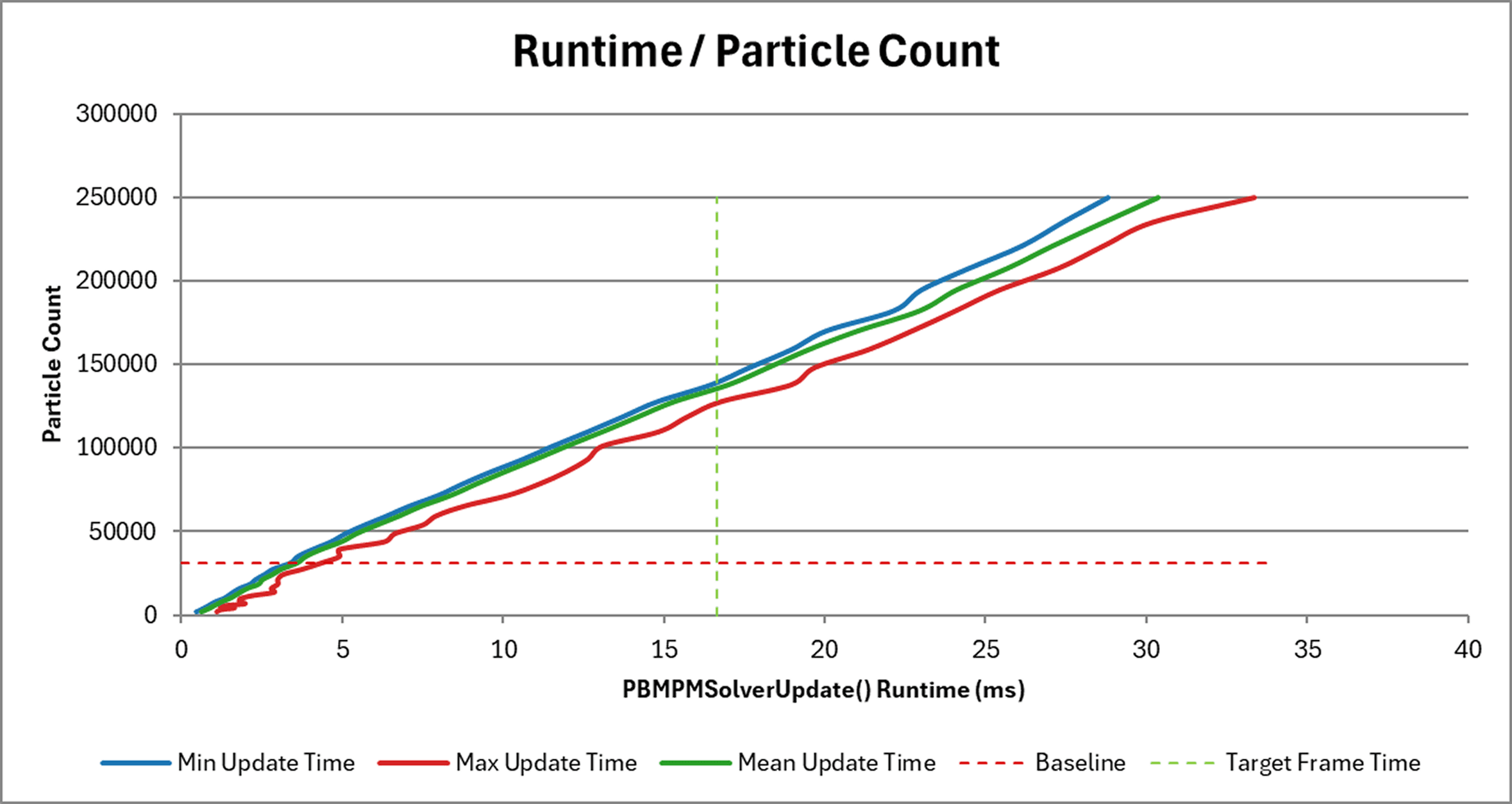
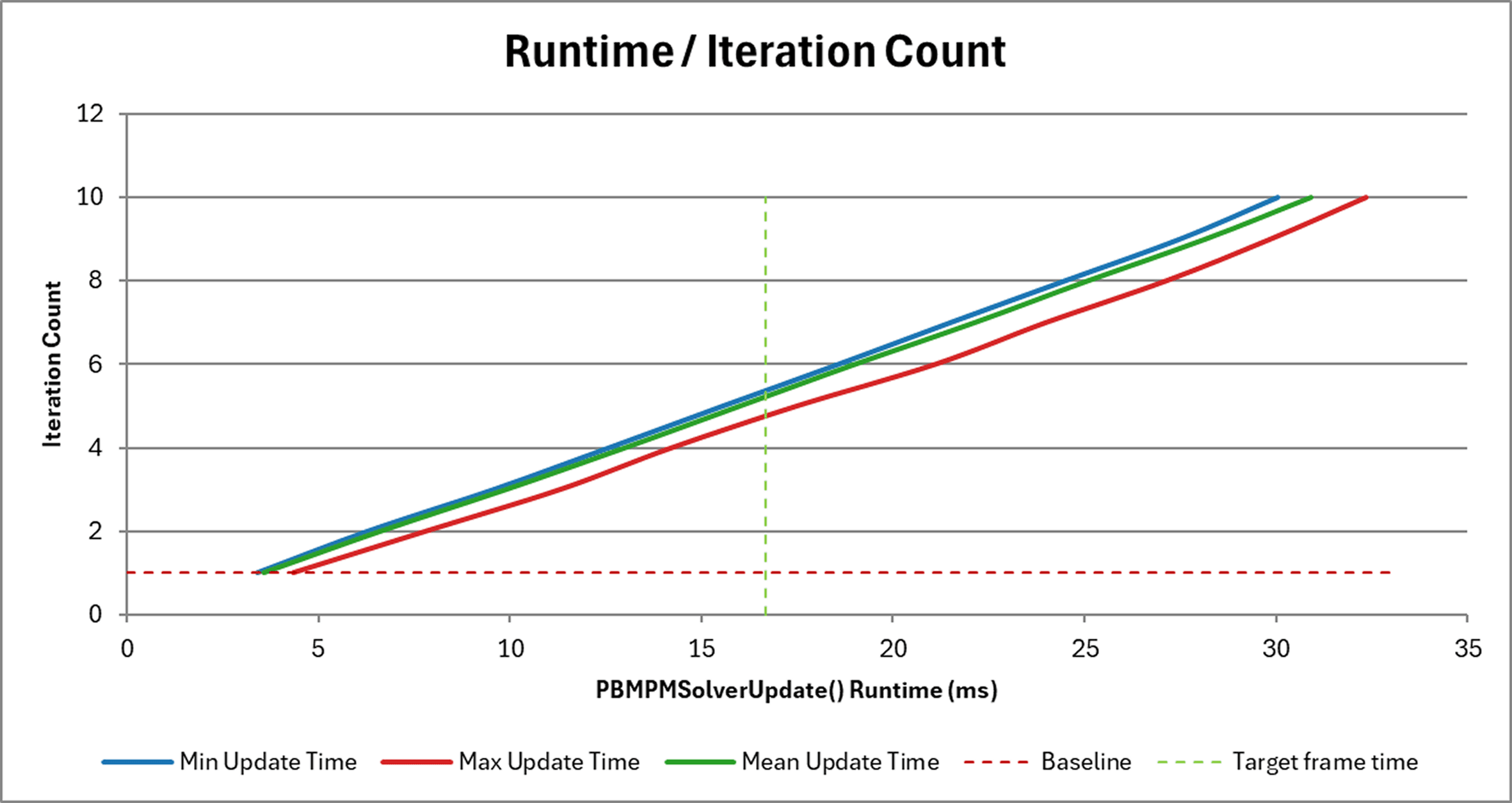
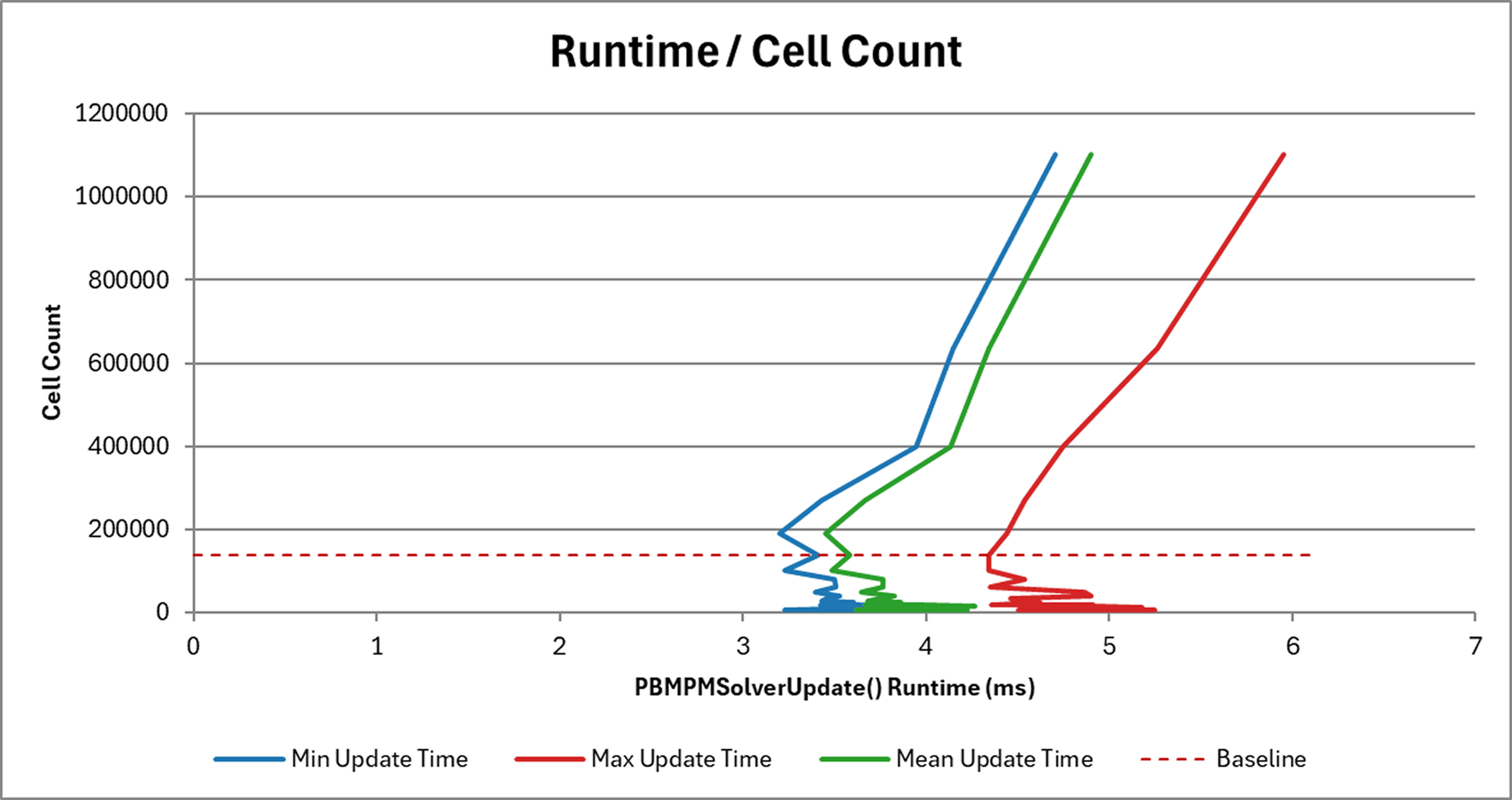
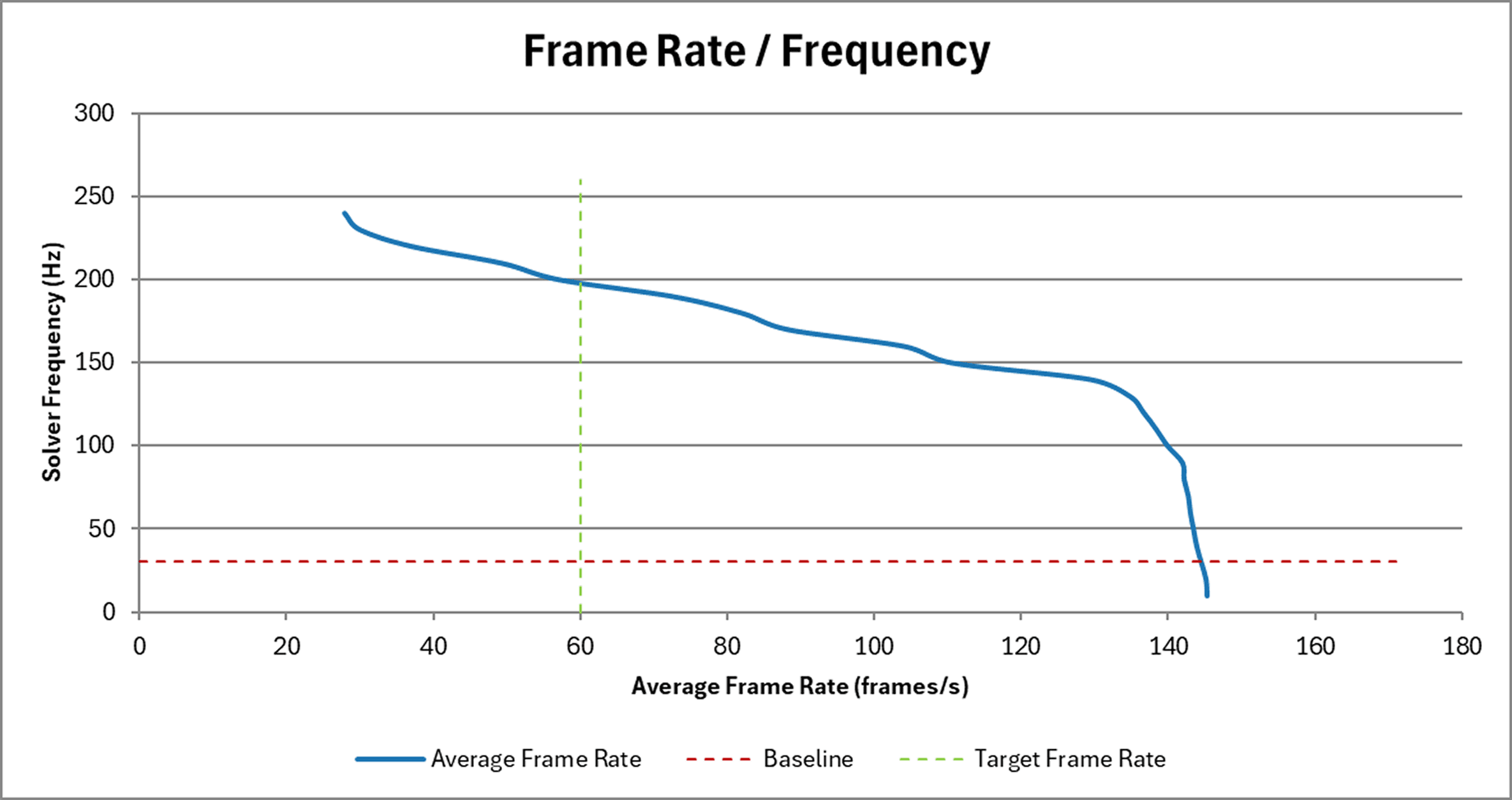
Particle count and solver iteration count both scale runtime close to linearly and are the two most direct cost controls. Grid resolution is more nuanced: because the implementation groups particle-to-grid work into active tiles, there is a practical runtime optimum around the baseline cell size rather than a purely monotonic relationship between cell count and cost. Solver frequency does not change the cost of a single update, but it determines how often that cost has to be paid, which is why frame rate collapses once the requested frequency outpaces what the prototype can sustain.
Memory Footprint
Alongside runtime, I measured how much memory the solver itself owns as particle count and grid resolution scale, using the Unity Memory Profiler. This separates the total allocated and resident memory of the whole player process from the solver-owned memory, which only counts the PB-MPM data structures: particle components, grid cells, and the tile-particle cache used by the two-stage particle-to-grid transfer. At the baseline configuration, the solver owns 31.03 MiB, of which the tile cache alone accounts for 20.12 MiB.
Key memory measurements from the thesis:
- Particle count: solver-owned memory rises from 8.29 MiB at 2,000 particles to 31.03 MiB at the 31,250-particle baseline and 201.08 MiB at 250,000 particles, roughly O(P). The tile-particle cache alone grows to 160.96 MiB at the highest particle count.
- Grid cell count: solver-owned memory rises from 24.58 MiB at 5,202 cells to 31.03 MiB at the 137,700-cell baseline, 77.10 MiB at 1,101,600 cells and 264.45 MiB at 5,110,200 cells, roughly O(G). The direct grid-node storage alone reaches 238.03 MiB at that finest resolution.
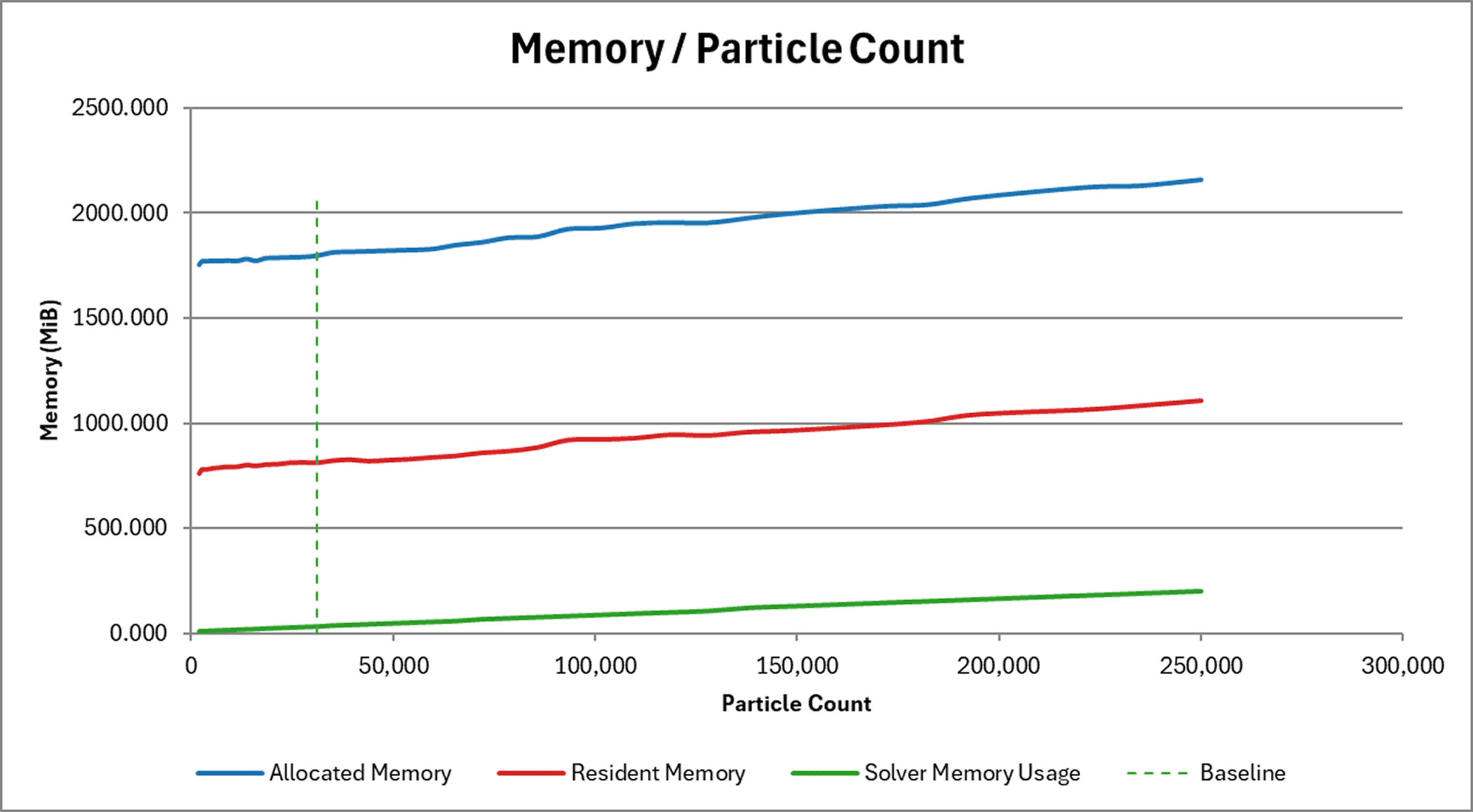
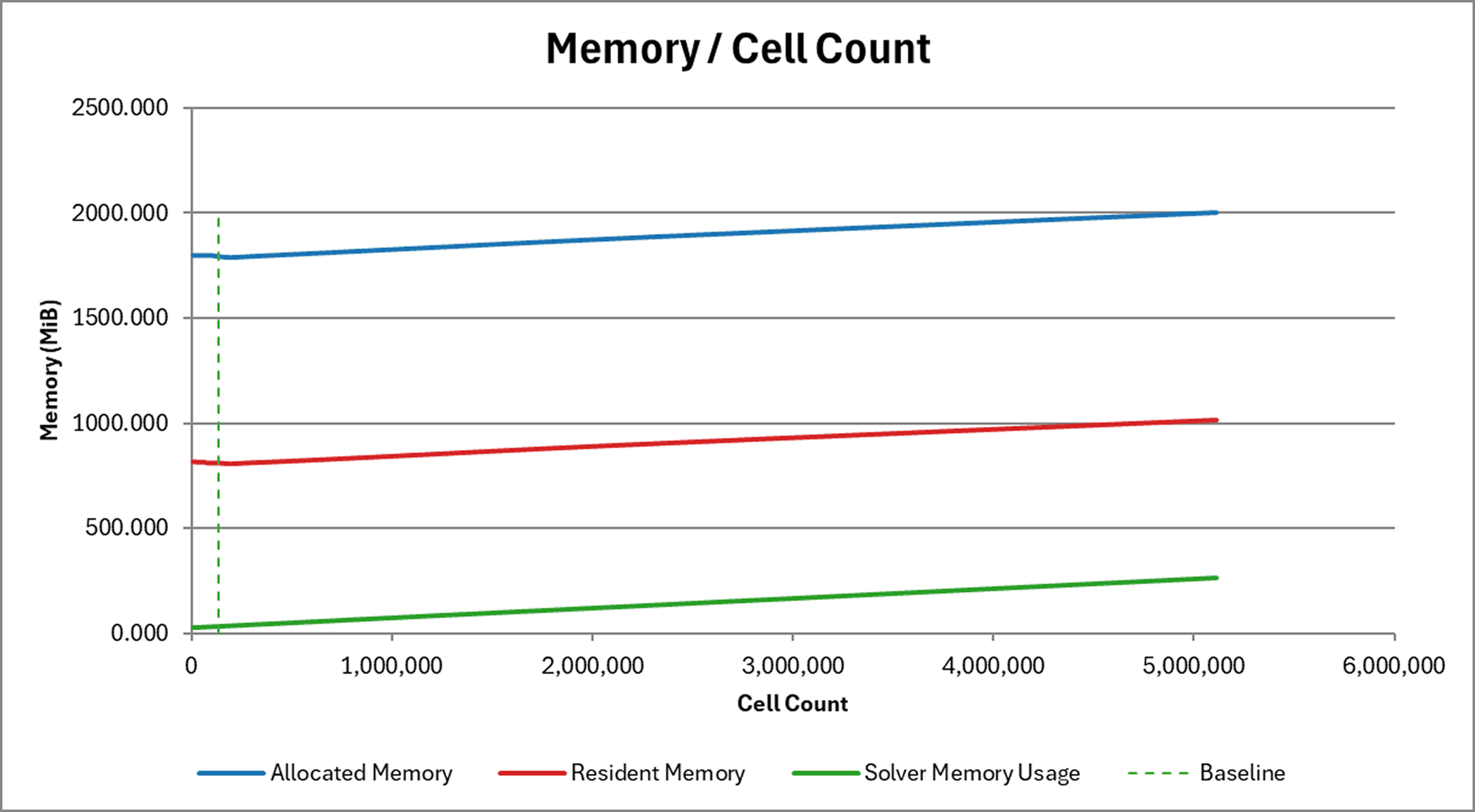
Together, the two series show that solver-owned memory scales approximately as O(P + G). Particle count drives memory through both the particle components and the tile cache, while grid resolution drives it almost entirely through persistent grid-node storage. This means grid resolution can be a relatively cheap runtime choice while still being an expensive memory choice, so the two costs need to be tuned separately rather than assumed to move together.
Is This Practical For Games?
On its own, the baseline update time of 3.428 ms is comfortably inside a 60 fps frame budget of 16.67 ms, and even further inside the 33.33 ms budget of a 30 fps title, which remains a real reference point in console development. Naughty Dog's SIGGRAPH material on The Last of Us Part II and Monolith's post-mortem for Middle-earth: Shadow of War both describe 30 fps on console as the frame-budget target that optimization work was measured against. The solver-owned baseline memory of 31.03 MiB is similarly modest.
Being affordable is not the same as being worthwhile. In many games, liquid is mostly decorative, and a shader or a simple particle effect will usually be cheaper and good enough. A physically based solver like this one becomes interesting once liquid behavior is part of the actual gameplay, when players can redirect, accumulate, drain, or otherwise manipulate flow and pressure to solve problems rather than just look at them.
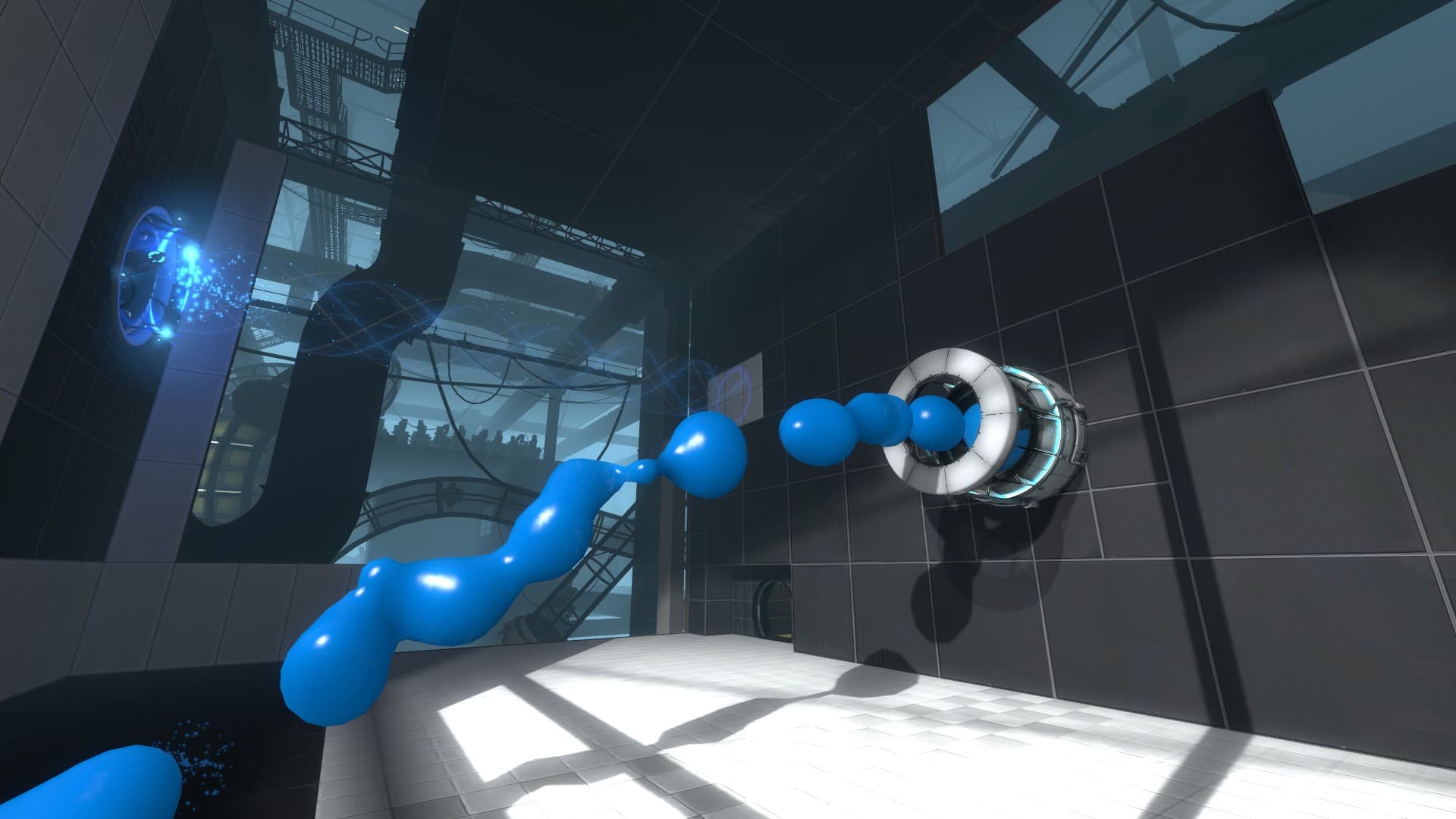
Portal 2's gel systems are a useful example of that idea: the material changes movement and surface behavior, so it becomes part of the puzzle rather than a purely visual effect. Under that lens, the measured baseline and scaling behavior from this thesis suggest the implementation is viable within a carefully chosen parameter range, provided the liquid is central enough to the design to justify its frame-time and memory cost.
Current Limits And Next Steps
The current prototype is intentionally narrow. It implements only the liquid branch of PB-MPM, resolves collisions only against box colliders, and renders the fluid as individual particles rather than a reconstructed surface. All measurements were also taken on a single hardware configuration, so they show how the implementation behaves on that machine rather than predicting its behavior on lower-end CPUs, consoles, or handheld devices. The evaluation itself was carried out in controlled prototype scenes rather than a full game competing for the same frame-time and memory budget, and the validation was qualitative: it checks for visual plausibility and the absence of obvious failure cases rather than validating against analytical or reference solutions. The visual smoothing pass also only improves the rendered motion; it does not change the underlying physical update rate, so smoother-looking motion should not be mistaken for a more accurate simulation.
The most direct follow-up work is support for elastic materials and sand, broader collider types such as spheres, capsules, or compound colliders, GPU acceleration for the particle-to-grid stages, and a surface reconstruction and shading pass that presents the liquid as a continuous volume instead of debug spheres.
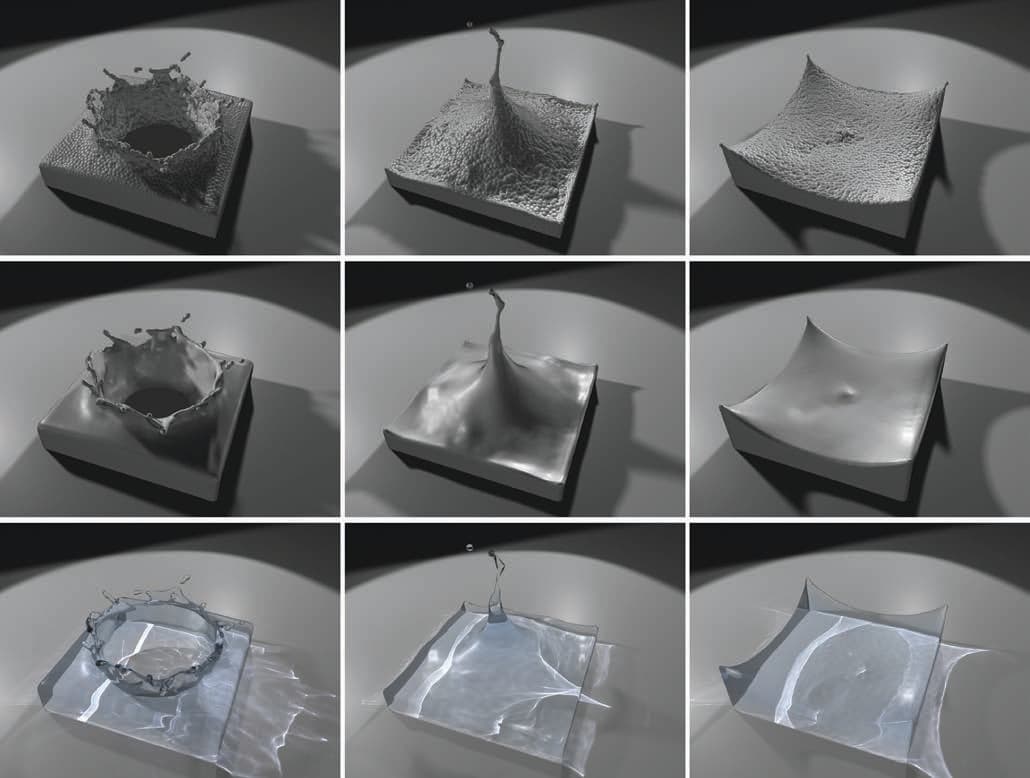
Within that scope, the thesis shows that a PB-MPM liquid solver can be mapped onto Unity DOTS in a way that is explicit, profileable, and still compatible with real-time budgets when fluid behavior is meant to support gameplay rather than act as a purely cosmetic effect.